< Gavdos Island | Northern Crete >
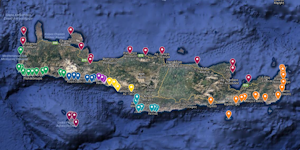
↻ Clockwise: East to West then northwards along the West coast - green spots on the map above
Along the Southern coast from Agios Pavlos to Paleochora, most of the beaches are excellent for wearing your birthday suit. Some contributors have the distinct impression that everyone was there for the same reasons, namely, peace, tranquillity and a great area for nude bathing and swimming. As always, use discretion. In July 2020 everything in this area was operating pretty normally except a little quieter usual due to Covid 19 so it's a good time to go, relax in the sun and support local businesses.
Aghios Pavlos
1 hour walk to the East of Agia Roumeli. One contributor describes this as probably the most beautiful nude beach in West Crete. No sand but the fine pebbles are OK. There is now a canteen so that food is no problem. The beach is over a kilometre long. Summer sees a few textile Greeks who come by boat but otherwise it is still very unspoilt. This may be due to the fact that you have to walk to it: one hour from Agia Roumeli or 4 hours from Loutro or 1 - 2 hours down from Agios Ioannis. Camping is OK.
Another contributor found this beach slightly disappointing. It is the situation, below wooded slopes, that's remarkable rather than the beach itself. And the walk from Agia Roumeli is more gruelling than the distance suggests, over pebbly beaches and soft sandbanks. Our part of the beach (just E of the old chapel) had some litter of discarded camping equipment. There was a strip of dark volcanic sand, but entering the sea was particularly awkward over grapefruit-sized stones. The beach is so long that these details probably vary. The 'canteen' is now a solid two-storey building that styles itself as 'restaurant', though it's still pleasingly ramshackle and cheap. We saw few naturists staying very long, though almost every walker coming through paused for a brief nude swim. This beach is perhaps best seen as a pleasant stop-off before the lovely walk on to Loutro rather than as a naturist destination as such.
2020: A contributor: Walked from Roumeli, I think it is a nice walk and it is worth it. If you can walk an hour it is no problem, you can have a swim anytime on the route.

Samaria Gorge & Agia Roumeli beach
Samaria Gorge walkers who want to spend some time sunning and swimming nude after descending the gorge should try the little rocky beach on the east side of the village in Agia Roumeli. To get there, simply follow the river until it almost reaches the sea, then cross it and walk approx. 300 m eastwards (following the E4 footpath) until you get over the low cliff sitting on the edge of the water. Turning back along the shore you have a little area with nice, smooth rocks, shady caves and wonderful clear blue water that you can dive straight into. The area is very sheltered from view. When my contributor visited for the second time in May 2001 it was exactly as he remembered it from his first visit 25 years ago. It does not seem to get crowded; this time there were three women there, two nude and one topless, in addition to my correspondent and his friend. Strongly recommended, a better option than stripping off at the far end of the main beach.
The town has the atmosphere of a terminus. It's particularly dire as you walk out E between the helicopter pad (all concrete and steel wire) and the local marshalling ground for litter bins. Then everything changes at the river mouth. There's a small picnic and camping place under trees (remarkably litter-free when we were there) and after 300m the delightful bathing place. Behind you the town is hidden by the low headland, in front the lightly wooded bay arcs round to Aghios Pavlos and beyond. Nor is it just a place for naturists to hide in the caves. As we swam, two mixed couples sunbathed in full view of the E4 path, while others took advantage of the caves for shade.
A correspondent from 2004 confirms that it is still a good nudist beach beyond the rock at the east end, with good snorkelling.
In mid-September 2015 there were several nudists at the west end of the Agia Roumeli Beach. The bulk of Samaria Gorge walkers stay near the ferry terminal end of the beach.
2020: Near the river and east of it people are camping, some nude, no problem. Nice place to swim and wash the salt off in the river. Go a little further to the east through the goats' gate and there are nice coves on the beach.

Kalogeros
A kilometre west of the village of Agia Roumeli is the wonderfully remote Kalogeros beach (Monk Beach). A motorboat or canoe is required to access it, which the contributor did in mid-September 2015. It was 100% nude - the writer and his wife for about 5 hours. A clothed couple on a motorboat stopped for a short time but other than that it was like Robinson Crusoe and Girl Friday.
Apartments at the excellent Sweet Corner Masxali at the west end of the Agia Roumeli beach have canoes which are free to folk staying at the accommodation.
Swim 300 metres west to Fournoti Beach where there was another nudist couple.
At the last bar on the beach you can rent a kayak (€5/hour in 2020) and visit the beaches on the west. Sometimes a boat stops with clothed people, but they can keep at distance if they want to.

Sougia
Sougia, also on the South coast is quite long and although I was told that the nudist section was at the Eastern end, in a bay, in fact you can bare all once you pass the level of the last building in the village. But, beware. The beach is pebbly/stony and there is a steep and uncomfortable slope down into the water. And when the weather is warm the stones get far too hot to walk on in bare feet. You may want to bring some water shoes to protect yourself entering the water.
To get there by car turn to the left at Sougia's embankment and drive till the end of asphalt road. Then continue driving by unpaved road along the sea till parking. Now you are 200m from the naturist part of the beach.
A correspondent who visited in 1998, back-packing, described the beach at Sougia as one of the most beautiful beaches they had been to. Naturism is very acceptable throughout the beach but we needed to respect the locals on Sunday. You can go beyond a rock on the eastern side of the beach where there are natural springs and caves. It is very private in that area so you can feel free to be free. The downside was pebbles, but sleeping on the beach without worries was the best. A lovely beach with a relaxed atmosphere.
The Captain visited in September 1999 and again in 2003 and confirms the above reports. Swimming here was a delight.

A report from June 2001 notes great swimming, with clear water and fish. The rocks at the far end of the beach created a nice kids' pool. The beach there was very crowded with families, little kids, singles. 90% nude except for locals in street clothes. It would be perfect with fewer people.
There was, apparently, once a sign prohibiting nudism but, as in the past, in 2001 it was ignored by large numbers of people including many who encroached beyond the usual limit.
The beach is bordered by trees just below the town. This area is thick with free campers, but the beach was clean. People were naked 50 metres from the town edge. My contributors could see them while they ate breakfast at one of the beach-side restaurants.
Contributors who visited in September 2002 spoke of lodging at the SE corner of the town from where they had only to walk diagonally across the beach to enjoy a pre-breakfast swim, and watch the sun light up the surrounding hills as we floated in the warm clear water. Where else is that possible except in a naturist resort complex? Yet Sougia's no naturist ghetto, having a selection of shops and tavernas and especially-friendly local people. True, the beach is small stones not sand, but there is no difficulty entering the sea. Almost everyone on the beach from 100m east of the river bed was nude, even at the weekend, and the few textiles tended to be in an enclave - rather the opposite of the usual situation.

Previous reports suggested there was a lot of litter on the beach. More recent ones indicate that the beach is now kept much cleaner.
Contributors in the summer of 2004 confirm that cave campers were causing some litter, but that there was happy coexistence on the beach with textiles, though the cove at the end of the beach was 90% nudist. The water was deep enough to allow one to jump, naked, from the island rocks at the east of the beach, and the north end of the beach was particularly nudist-friendly. One worrying report from August 2005, however, came from a Greek contributor who, with his wife, was facing a Summons to appear in Court in November for camping at Sougia two years ago; he had enjoyed visiting Sougia every year since 1988, and this has left a very nasty aftertaste. Perhaps a warning to the rest of us to continue to take extra care to avoid doing anything which might upset anyone living in the localities we visit.
Barefooters who visited in May 2006 described it as still wonderful and peaceful; however be aware there was nowhere to change money or travellers' cheques in the village at that time. Visitors that June said there were mainly couples and single females of all ages. Shingle and stones, with no facilities whatsoever except for a shower. Immediately to the east of the tavernas, almost everyone was nude, with just a few textiles further along the beach to the west. Walking along the water's edge was very pleasant. Quite a few campers and people in camping vans behind the beach. Very relaxed atmosphere. Sougia is probably easier to reach by the daily ferry boat than by road.
The situation in mid-September 2008 had no changes from what has been described above with the eastern part of the beach busy with nudists. What was marked was how few people there were on the western section of the beach perhaps highlighting how much Sougia depends on the naturist trade.
Reports from 2010, 2011, 2012 and 2013 confirm above. The beach is still pure naturist paradise.
Report from 2014 - Same as above. Sougia was the first place I went naturist 'with' other people around.
Report from 2015 (various visits during Spring & Summer) - Still great. However, the far east end of the Beach (see the photo above) is increasingly being used by textile-wearing visitors too. For the most part this is an easy-going co-existence which seems to work out fine but on busy afternoons (say from 3pm onwards) and especially in season, there are occasions where you can find yourself encircled by textile-wearing beach loungers with yourself nude in the centre and this is certainly a test of fortitude if nothing else. Occasionally I've spotted nudist couples (all western / northern Europeans in their mid-50's and upwards) at the far 'west' end of Sougia, close to the harbour, something which to me has the potential to cause some friction between those doing it and the more conservative locals or visitors who wish to keep naturism in one distinct 'eastern' area.
May 2016: majority of users on eastern half of the beach nude. Textile visitors soon took the hint and stripped.
Early October 2016 the nudist half of Sougia beach was busy with people 'au naturel'. The half of the beach in front of the town was quieter by comparison.
2018 : Naturism lovers who, have for years (even decades), enjoyed long naturist camping stays on Sougia's beach should be aware that in late 2017 a vote took place in the village, with a decision by those eligble to vote, to ban camping on the beach - at least for 2018. Officially, this has always been the law of Greece but for many years free camping has been permitted / tolerated by the village because it was a symbiotic relationship which benefitted everybody (local economy, and convenience for naturists who sought to live simply and cheaply). It remains to be seen if this will remain, but to ban it (using a rather unconvincing excuse about archaeological preservation - suddenly a problem after 30 years?) seems to be economic self-harm for the village. Some reasons given for banning it, are valid. Others, less so. Unfortunately, those of us who were sensible and left a very light footprint, are being collectively punished for the actions of thoughtless people in the high season month of August. Naturism continues on the beach, but it is best to place this information on here before people fly from other parts of Europe intending to spend months naturist camping in Sougia in 2018. It is possible that once the season begins in 2018, the economic folly of this decision may lead to a reversal of policy, but time will tell.
July 2019: Camping and naturism on the beach is about the same as 2 years ago.
September 2023: Naturism on the beach is about the same as previous entry. The place is quite windy some days…
Lisos / Lissos

From Sougia there's no need to seek out naturist beaches, but my contributors can't have been the first hot walkers to swim naked at the inviting little beach below the ancient site. The hour's walk from Sougia is through an especially pretty gorge, and the site includes the finest mosaic (below, right) we ever saw outside a museum (where this one probably should be).
Summer of 2004: two reports, from early and late summer, report tar on Lissos beach - otherwise fine.
September 2008: The beach was still fine for nudity.
July 2010: a contributor found various walkers and a textile Greek family that had arrived by boat. The trek over from Sougia seems to have become very popular. The situation varies, so go with the flow.
Reports from September and October 2014: Lissos Beach was generally textile by 'default', and anything different meant visitors gauging those around them. Deciding whether or not to go (or stay) nude was, as Captain Barefoot suggests in this article, a case of going with the flow on the day, or making the first move to go nude (which, more often than not, as found in other parts of Crete, would actually cause a domino effect once you set things into motion).

Visiting earlier in the day (say, before 11am) or later afternoon is probably best if you are fully 'intending' to go and be nude on Lissos beach, rather than as a spontaneous decision following a hike there. Earliest boats from Sougia to Lissos are around 11am, if memory serves. It was common to have the beach to myself when hiking to Lissos in the morning from Sougia. Once 12 noon comes, and until 5pm or so, it then depends on the people around you, or courage.
In early to mid-September, Lissos beach was generally being visited by individual hikers or couples joining E4 from Sougia or Paleochora, or taking the small boat from Sougia, leading to some women choosing to go topless, and sometimes nude swimming. In later September and into October, there seemed to be a rise in large formal hiking 'groups' who were stopping at the beach while on the E4 hiking route from Paleochora to Sougia, many of whom were much older members of European society going to great lengths to retain modesty. It is worth remembering that boats also come from Paleochora, and sometimes families visit the beach so use common sense and moderation.
On my later visits to Lissos Beach, if I had been there nude for hours already, draping a towel over me lightly until gauging new arrivals was best when a new boat first approached. If everything then felt too conservative afterwards, I would swim to areas around Lissos beach (many great and secluded places west and east of it, accessible by rock hopping or swimming).

Anidri (Gialiskari)

Everyone seems to know these beaches as the Anidri beaches, although the Captain is advised that their correct name is Gialiskari, and that is what the sign near the beach says. On the way to Gialsikari there is also an unofficial sign saying Anidri Beaches with Taverna and Massage though. Anidri is the village to the north of this beach. From there you can reach this beach by walking down through the riverbed. Of course most visitors use the dirt track from Paleochora.
There are three very wild and beautiful beaches in the local guide book, 50 minutes but really about 1 hour 15 minutes brisk walk from the centre of the town. These are east of Paleochora on the E4 long distance footpath to Sougia via Lissos. This path has now been upgraded and has the status of a rough track - driveable with care. There are signs asking people not to drive on to the beaches themselves. The approach is along a rugged stretch of coast under clay cliffs which eventually goes round a promontory with an unfenced drop of about 60 ft. It is safe enough but the local guide does emphasise the exposure. Young children would need special attention, apart from the fatigue of walking on a south facing coast in hot weather. A long beach of coarse shingle runs parallel to the path, and is unoccupied apart from the occasional nude couple but it is not so good for bathing.

The three Anidri beaches are really worth visiting. The nearest two are pebbly (but better than the long beach nearer town). The farthest beach is much the nicest. It is fine shingle and sand and is more sheltered, with large rocks on the western end offering some protection and privacy. A natural spring feeds into the sea here. All my correspondents seem to have really liked these beaches as they were usually nearly deserted during the week and other users were generally all families and nude. However, at weekends during August, families of textiles apparently arrive by boats in large numbers - although co-existence seems OK.
Only the last beach on Gialiskari is used by nudists and then only half of it. Both parts have their own shower and are divided by the hut of the massage lady. The Captain hears she gives great massages. Very good after a long walk over the E4.

The most easterly beach is of sand blown up into a dune, with a bowl of shrubs and bushes behind giving shade, then a backdrop of the same cliffs. The ten yards before the sea are fine (0.5 - 1cm) shingle, which is ideal for swimming. The water shelves steeply to more than 2m about 5m out, but this did not pose problems for average swimmers. A swimming 'length' is about 200m, although the beach being curved is longer than this. There is a current which flows out of the ends of the beach when waves are driving on to it (it is easy to drift out when about 100m offshore at the end of the beach). The other two more westerly beaches are on a short promontory and are shingle with less shelter behind. Walkers along the E4 are no problem, most of them strip off and join you when they arrive from Sougia. Taverna near the parking offers foods and drinks.
There are signs of camping behind the beach but camping is likely to spoil what is a litter-free, cigarette-stub-free area. There were only about two dozen people on the easterly beach early in October with perhaps half a dozen on the other two. In summer there are more people but the walk is going to be more difficult and from the general level of wear and tear it seems these beaches do not become overcrowded.

When the Captain visited in September 1999 on a disappointingly windy day this large and beautiful beach was practically deserted. However a kantina had sprouted at the back of the middle beach, largely used by locals. It did not seem to have any effect on the use of the main beach by naturists.
Here is a report dating from 1997. "We walked along the E4 footpath towards Sougia. The walk was very pleasant, and not as difficult as we were expecting. There were also lots of people and all of them fully clothed - many of them families with small children, until we got to the last of the Anidri beaches, where almost all the people were naked. This is a very nice shingle beach, clean and litter free. At about 3 pm, a pleasure boat arrived and disgorged 50 or so people, all clothed, onto the beach, driving almost all of the nudists into the rocks. The boat anchored for about 90 minutes, but was very off-putting for some people. In spite of this, we both had a brill day out."
A 1999 correspondent reports 50/50 with/without clothes and no problems being nude. Let us hope this does not change with the advent of the road.
A year 2000 report from a local from Paleochora - who happily strips off on his way to the beach - confirms that this is still usually a 100% nude beach. However, another report suggests that one of the beaches is now equipped with beach umbrellas. Let us hope this is not another delightfully natural spot about to be ruined.
Another report suggests sunbeds and umbrellas are now spread on the whole Eastern beach in TWO rows!!! You can still be in the nude, it seems that there is a natural spatial division occurring between nude and textiles (about 50 - 50). The upgrading of the E4 footpath means that the old spirit of trekking from Paleochora seems to have gone.

Correspondents who visited in May 2001 went to the furthest of three beaches. It is a lovely sweep, forming a small bay and sheltered if the wind is from the west. Very clear water, pebbles and fine shingle, not too steep so OK for nervous swimmers. There were about 15 umbrellas in a single line round the beach, but plenty of space to make your own spot nearer the water or by the rocks at the West end. Most people nude, probably about 20% textile. A delightful beach which they shall aim to visit again.
A contributor from June 2001 said the third Anidri beach was one of their favourite beaches with great swimming. It was beautiful, very clean with clear water and fish. The water is warmer on the east end of the beach (far end) probably because there is no current to mix the water. The water on both ends of the beach was warmer than Paleochora. It was 70% nude, uncrowded with a mix of ages (no little kids).
The sandy promontory at its western end hides a rather pleasantly ramshackle taverna and stops the noise of its generator being audible. Civilisation has also provided a couple of useful beach showers. My contributor admitted that the cost of two sunbeds and an umbrella was money well spent on a beach without natural shade. The umbrellas were well spaced, both rows were mostly occupied, and they had the effect of spreading out the available naturists over the whole length of the beach. It was only as they left that my contributors realised that textiles were crowded close together right at the far end: an interesting reversal of the normal state of affairs!
In July 2001 my correspondents found the northerly Meltemi very strong around Paleohora, yet the conditions here were perfectly calm. The sea had the tranquility, temperature and clarity of a perfect swimming pool, yet 1km back towards Paleohora the wind was strong enough to whip up sheets of spray from the sea surface.
The dirt road out to the beach is in fine shape. You don't need ground clearance. The only steep slope has been concreted and any small car should be able to make the trip. The only danger is if you drive really fast you may cut a tyre. Ours was the only jeep in the parking lot, everything else was Fiat Pandas and Citroens. There is dedicated parking for the third beach, and you can leave your clothes in the car. My contributors also went for a nice hike up the E4 trail at the end of the beach and didn't bother getting dressed for that.

A report from September 2001 found the Anidri beaches completely textile on a Sunday. It is not uncommon for the nature of beaches to change at weekends when (typically - but not uniquely) textile local people tend to use the beaches. They were 50% nude the rest of the time.
A contributor who visited in May 2004 said great disappointment was experienced at Anidri where the pebble/shingle beaches remain very exposed and the easternmost sand beach now boasts 2 rows of sunbeds and whilst no more than 20 people were present none was nude, nor even topless. One would not consider the journey worthwhile especially in the light of the Trahili beaches.
Other reports from 2004 and 2005 are more positive. The sunbeds are 6 euros per day, the beach is well cleaned and attended, and the sea gave good snorkelling. The beaches were not crowded, though there were 50 or so nudists even on a Sunday. Nudist percentages at the furthest beach to the east varied from 66-75%. There are good possibilities for nude walks, too: one contributor walked nude for an hour eastwards along the E4 and saw no-one; another turned left just before the beaches (coming from Paleochora, presumably) and enjoyed a naked walk up the gorge and back. Another contributor tried walking nude up the Anidri gorge but met quite a few people coming down - they didn't seem to mind though. He tried again and met nobody. But the walk from Sougia is described as 5 hours hard slog - great views, however. There's a lovely beach of coarse grey sand about halfway between Paleochora and Lissos. If walking nude make sure that you don't fall onto the rocks and sharp thorns or you'll wish you'd been wearing motorcycling leathers or a suit of armour. At times your solitude may be interrupted by groups of walkers coming the other way.
A report from June 2006 confirms continued naturist use of the easternmost Anidri beach. The eastern half was nearly 100% naturist and very relaxed. There was textile traffic in the form of walkers on the E4 path, but this was not problematic. A parasol and 2 sunbeds cost 5 euros for the day, and the concession holder stripped off and had a swim himself at the end of the day. Other reporters have seen him cleaning the beach every morning.
A visit in late September 2008 found the eastern half of the east beach occupied by about 20 people and 100% nudist. There was less folk in the non-nudist western half of the beach.
This is the contributor's favourite European beach and the one where his wife first experienced the joys of going 'au naturel' some years ago.
No significant changes in 2010, 2011, 2012, 2015, 2017
Recent reports
In early October on a Thursday, the naturist part of the beach was busier than the writer has ever seen before. In comparison there were very few in the textile area.
Apparently the beach is mentioned in the Tourist Office brochure on Paleochora as being nudist.
Visited Gialiskari beach on Friday 29th Sept 2023. Drove there on a poor road (although now discovered there is a free bus from Paleochora). Turned left at the sign and parked behind the snack bar (note there is another snack bar on Anidri beach). Good idea to park under a tree. To the left of the snack bar (as you look towards the sea) there are two lots of parasols/sunbeds, the first lot are all textile, but beyond that it was 100% nude. Fine gravel beach. The sea was lovely but "jelly shoes" would help.
Paleochora

The town is on an isthmus about 1 mile long stretching south into the Mediterranean. It is backed up by mountains in a very beautiful area of Crete. The isthmus is about 600 yards wide in the middle. On the west is a famous long sandy beach about 3/4 mile long used for windsurfing in the season (apparently its official name is Limnaki). The beach is composed of that kind of powdery sand which is perfect for sandcastles but sticks to wet or sun-cream-treated skin. Nude swimming and sunbathing is practised on the last 300 yards at the north end of the beach (towards the far end as seen in the picture). There is a parking place behind the beach.
There is a taverna at the northern end, and the owner requires customers to dress before coming to be served. There is textile traffic along the beach as well as some textiles or topless in the naturist area, but everything is very relaxed. A nice beach, good sand, good bathing, easily accessible and very relaxed. Many people come back here year after year.
The Captain is delighted to report that notwithstanding the age of the rather old reports on this page, very little had changed in 2014 and the beach is still popular with naturists. On one of those wonderful, calm days you occasionally encounter the sea is especially beautiful here. There are some flat rocks at the entry to the sea at some points, but it's easy to negotiate them or swim over them. Some beachgoers used swimming sandals, but the Captain did not think them necessary.
The signs near the taverna are in much politer language than in earlier years. One side pleads "No nudism beyond this point, please", while the other side says "Nudism beyond this point, please," as if it were a requirement. How could anyone refuse such a polite request?
Yet another correspondent thoroughly recommends Paleochora. He says the Western side was the only one they visited and the northern part of that was about 75% populated by nudists - mixed couples, families etc. There is a beach bar at the top of the beach but at least a G-string is required here.
In recent times signs have sprouted on the section approaching the taverna declaring "No nudism here, keep this beach clean" and another, "No nudism here ", as if the two ideas were somehow connected. When the Captain visited in September 1999 these signs were being roundly ignored with a large section of the western town beach remaining staunchly nudist. A very high percentage of people were nude. A report from June 2000 says 80% nudist within 100 metres of the sign; after all, how else would you know where to go? The stream of textiles walking past is more of a discouragement than the sign is. The water seems to be very clean. An excellent beach for bathing.

However, the signs may have increased the distance between the northerly end of the nudist section and the taverna, and might make nudism more difficult in peak season. In 2002 worrying reports have started to creep in that Paleochora is now textile except for a small enclave of 20 or so umbrellas at the northern end and a few bits behind the rocks. Other reports say nudism is still practised on the town beach and that the signs are there only to deter nudity close to the bar. People both clothed and not were walking up and down and no-one seemed too worried. If you are going there this summer please report back!
The beach can be windswept. Sunbeds and umbrellas are available for hire even on the nudist section and even a shower is available.
The Captain has received (July 2001) a report from a couple who are regular visitors to Paleochora. The two guys running the beach umbrellas, Fotis and Giorgos, continue to conspire to make naturism possible. As long as one observes the natural boundaries at either end of the nudist stretch, there is no problem. However, Giorgos was summoned to a meeting in Chania with the port police, the tourist police and the community police, following a complaint. There have apparently been articles in the local press. Now that there are houses overlooking the beach, people have got a bit jumpy. A swoop from the police was promised but never happened. Fotis and Giorgos know which side their bread is buttered. A large number of the nudists are independent travellers, keen to put money into the local economy rather than into multi-million travel companies. They do well out of us and are keen to keep it that way. The sign that was erected in the middle of the nudist stretch a few years ago has gone and my contributor suspects that any future ones will also disappear. You do get such strong winds in Paleochora …
In my contributors' third week they hit the beginning of the Greek holidays so inevitably there were people - we suspect from the north of Crete - wandering round tutting and humphing. There was also a woman with a video camera. Everyone ignored them. For several years we have worried that our lovely bit of beach will go textile. It's still very much OK! And a report from September 2006 speaks of a naturist couple who went into the sea near the shop and were shouted at by a Greek woman who sat outside the beach shop on guard. The couple were scared to come out of the water.

Regular submissions of up to date information on Paleochora beach are welcome. The situation is clearly changing all the time. Reports from June 2003 suggest that it is still possible to swim and sunbathe without clothes at the northern end of the western beach between the outcrops of rocks, not going near the cantina. The Captain made it back here in September 2003 and can confirm that at that time the nudist section was active and busy.
Reports from 2004, 2005 and 2006 are generally still very favourable, several commenting on the welcoming atmosphere. Contrary to some earlier reports, the general attitude seems to be very tolerant. One correspondent noted the presence of more women than men! Another noted that most were families and couples; there were about 50 nudists on the beach that day. Sun umbrellas have made an appearance, at 5.50 euros per day. There is some building by the road overlooking the beach. Nudist use varied a lot, occasionally none at all, rising to 80%+ more commonly. The sandy beach could be unpleasant if the wind was strong; but although there was nudism practised on the pebbly East beach, the large pebbles made walking and approaching the sea uncomfortable.
A report from early June 2006 confirms that the sandy beach at the northern end remains naturist. Lovely pure sand and very relaxed atmosphere, with parasols and sunshades available to rent. The signs referred to above (no nudism etc) are right next to the beach bar, rather than in middle of naturist section. Barefoot reporters visited the bar for a fresh orange juice, having donned bottoms. The girl at the bar politely asked the female partner to cover her top as well, necessitating a walk back to their parasol for her bikini top. There were some passing textiles on the beach but this caused no problem.
A report from late July and early August 2006 says that the sunbed owner is unfazed by dealing with nude people and says "Have a nice time" to each customer. The atmosphere seems very friendly and relaxed in spite of some dressed people walking up and down and the appearance of a public car park just above the beach. There are also more buildings on the other side of the road overlooking the beach but this does not seem to cause a problem either. Another report from August 2007 confirms that the beach still attracts lots of nudists, although its character was really "clothes-optional". The beach was nice and beautiful and the sand was clean.
But the beach can be very windy, Grameno is better then.
In Paleochora you can rent a bicycle for 5 euro a day including helmet and lock, and you can go to Grameno beach or Anidri.
Recent reports
July: Just look for the "FKK-strand" on google maps (https://goo.gl/maps/422aTuJfSNYJvNsD9) - i.e. to the west of the town. Several naturists, couples and single males, very nice place indeed with a few parasols available, no showers though. Easy parking next to the beach.

To the east of the town, a long pebble beach with here and there a little sand which, beyond the camp site and night club, is usually deserted. The few swimmers that do use this area are usually nude but it is steeply shelving and the pebbles are large and uncomfortable. However when the wind gets up on the sandy beach the discomfort of the stones is less than the discomfort of being sandblasted. In town at the end of sunbeds the pebble beach turns a slight corner and there seems to be no problem with being nude even 50 m beyond this point in low season. In July 2013 the sunbeds and parasols on the town beach stretched round the corner making this section a little too busy with textile sunbathers for comfortable naturism. And in early 2019 exceptional winter rains brought a lot of river sand and small stones down onto the stoney beach stretching for hundreds of metres. The stones, previously so hard to walk on, have been replaced with a surface that children can run along but another winter could change the situation again.
A contributor in 2020: The last three times over a period of some years I have not seen any nude people on the eastern beach.
As ever use judgement when stripping off. In this region the West end of the Paleochora sandy beach, the East end of Gialiskiari (Anidri) beach and the East end of Sougia beach are very well established naturist venues where you are unlikely to feel out of place even when clothed people are around.
In 2019 there seems to have been an increase in topless sunbathing on textile parts of the beaches in the area compared with 2017. It's up from a very low base and nowhere near as popular as it was in the 1980's but it could be the start of a rising trend.
Visited the sandy beach at Paleochora on Sunday 1st October 2023 & the Monday. The far North West of the beach (the last set of parasols/sunbeds) is 100% nude. Before you get to the snack bar at the end of the beach there is a sign "no nudism after this point" which is fair enough. You can park where "Sunset View" is shown on Google Maps or further along the road, shown as "Parking".

Grameno, Trahili
This beach is to be found on the Trahili isthmus, 4 kilometres from Paleochora (perhaps five from town centre to car park). Trahili is an isthmus about a mile long rather like a smaller scale version of the isthmus carrying the town. The beaches are known as Grameno and Mammeno.
On the eastern side of the isthmus the beach is shingle with parasols and a taverna, and is 100% textile where the road arrives, but nudism is practised at the eastern end.
On the western side of the isthmus, it is mainly sandy. The first beach has parasols and a taverna and is 100% textile. Walking further along, there is a nice sandy bay which was mainly naturist and very relaxed. Good to swim from, a little secluded with dunes behind. Some bushes and trees provided shade, although a parasol is desirable. Walks along the water's edge were enjoyable. There is a third, smaller bay (which my reporters had to themselves) but it is difficult to swim from there, as there are rocks in the water. This report dates from June 2006.

A report from May 2004 suggests that the Trahili beaches offer much more scope and acceptance of nudity than earlier reports suggested. Travel past the beach turning for 200 metres to a lay-by with a telephone kiosk, and almost immediately two or three excellent small coves are available, virtually alongside, yet hidden from the road. A minimum of textile traffic was endured with no great problem. However, in May 2013 this area appeared to be dominated by the Houmas restaurant and nudity would not be possible.
At the end of the peninsula on and behind the two smaller beaches, innumerable opportunities exist within the dune-like terrain, for nude sunbathing.
Another report from the summer of 2004 says that the sandy beach (take the road between the greenhouses) is fine for nudism during the week, but overrun by campers at the weekend. A visit in May 2013 found a signpost to Grameno beach but no road between greenhouses.
Report from 2010: At our first visit we saw one naturist family and two textile couples on the beach. At our second visit the beach was initially 100% textile, but we decided to strip off and had no problems being naked there all the day. Some of the beach visitors were with a dog - dogs are prohibited at the main textile beach.
It seems the beach is not too popular among naturists now, but it is deserted and really worth visiting. Third bay was empty - nobody stays there as swimming from the bay is almost impossible.
Visiting in early June 2012 a correspondent found the area delightful with a pretty forest of short pine trees and bushes going out to a rocky headland. The beaches were much as described by others. Although the water at the furthest sandy beach was not very deep there was no problem getting in and out of the water or going for a short swim. But on a Sunday in July 2013 the same correspondent found a group of local lads in shorts on the beach and the crowds on the main beach much closer than in low season.
In a short mid-week visit in October 2014 the two smaller beaches were being used by nudists.
Krios

A correspondent in the summer of 2004 recommends this beach, which is 8 km to the west of Grammeno, on an asphalt road, well signposted. The western part, he says, is perfect for nudism: small pebbles, clean sea. There are also caves and green valleys above the beach which can be visited nude - again perfect!
The nudist beach is the one in the foreground.
A contributor and his wife cycled from Paleochora to visit this lovely pebble beach in September 2008. The beach is in two parts, separated by rocks. The smaller of the two beaches, as described above is the western one. It was interesting to note that whilst the eastern one was empty, the western nudist beach always had 12 -14 people on it through the day. The beach provides some windshield on windy days.
The eastern beach has a taverna and car park beside it. From the car park it is a 2 minute walk to reach the nudist beach.
Another contributor had less luck with Krios. It was well occupied with textile families on a Sunday afternoon but even on a slow Saturday morning a couple of textile groups on the Western beach were enough to make it feel inappropriate to strip off. Even so the café next to the Eastern beach is very nice even with your clothes on. Krios may be one of those places where if naturists arrive first they can set the tone for the rest of the day. A few years later in July 2017 the same contributor still found Krios more textile than not with only one young lady daring to swim naked.

In 2010 the beach was about 40% naturist during our two visits.
In early October 2014 in two mid-week visits to Krios there were up to ten couples in the western cove, almost all nude. Curiously there was no-one at all on the eastern 'textile' beach in front of the taverna.
In July 2015 there were about 12 people, all textiles. I walked to Viena.
Early October 2016 on two visits to the western cove there were about 20 people the majority nudist. Very few on sunbeds in front of taverna.
In July 2019 and September 2020 no nudists.


Viena
If Krios doesn't work out why not follow the E4 path 1.5 km or so to the next beach called Viena? The walk over hill takes about 45 min and quite enjoyable if it is not too hot (it is not recommended to walk in the middle of the day). This is quite interesting with some old marble columns from a collapsed temple lying in the sand. The beach is fairly small comprising several small bays of rocks, sand and stones. You will probably only be disturbed by the occasional walker making their way to Elafonisi or back. Update June 2016: Still a good prospect. The small bay pictured below has room for 3 or 4 couples and is perfect for nudism.

In September 2020 the small bay was visited by people (clothed) with boats who put up a tent and left it there. Plenty of room in the other bays. End of the season, mostly Greek people, all nude.

Kethrodassos (Kedrodasos)
An earlier report gave an indication of how to reach this beach; a visit in October 2005 gave the opportunity - after much trial and error! - to establish exactly how to get there.
About 500m before you reach the first buildings of Elafonissos, there is a small road at your left-hand-side. It is an asphalt road for about 5m and then continues unmade. Take the first turning left (greenhouses on the right) and the next left again. After a stone wall on the left, keep going straight on, and then turn right down a narrow pot-holed lane with greenhouses on the left; finally turn left again and you will see a car-parking area ahead (and a rubbish tip). The distance from the main road is 2.5 km. The beach is visible from this point. Go down the path and turn to the left as you face the sea. You can stop right there in one of the rocky bays, but swimming in the bays may be not convenient. Continue walking for about 400m to the main sandy beach.
The beach is filled with juniper trees and dunes of sand. (These are the small twisted junipers, commonly mistaken for cedars.) It covers quite a big area, and is a lovely spot: it must be wonderful for camping and you will see a lot of campers among the trees. Very nice beach with sand and some rocks. It seems to be protected to some extent from the winds that usually blow in Elafonissos. The European path E4 crosses the beach (there are yellow and black signs everywhere), so this is may be another hint.
Although my earlier contributors visited on a Sunday during August (which means that there were many textile families), nudism was practised (although to a small extent) not only at the beach but also in the wood and no-one bothered. Probably during weekdays or during June or September the situation will be much better. In early October 2005 the place was practically deserted - what a relief after the vast hordes of people invading Elafonissos just down the road! There is a sign at the bottom of the footpath from the parking area, telling those who are fluent in Greek everything about the beach: unfortunately my Greek is only good enough to confirm that I had found the beach I was looking for, and that its name is Kethrodassos.

Recent reports
mid-September: Kedrodasos is one of the most beautiful beaches I've ever seen in Greece. Both the large and small nearby beaches are perfect for naturism (100%). It can be reached by foot from the Elafonissi car park along the European path E4 (30 minutes), or by car parking in the area of the greenhouses near the coast line (10 minutes on foot)
October: Access to Kedrodasos by road is easy and although the last 1.5 mile (2.5km) of dirt track is a bit bumpy it is driveable in an ordinary car. On our second visit we walked from Elafonissi along the E4 footpath. The footpath is fairly level and not a difficult walk although it does entail clambering over some rocks. The path is well marked, just follow the yellow and black paint marks and poles. There are some great views along this route. It took us about an hour but younger, fitter people could no doubt do it in half the time. Along this route there are a number of tiny coves where being nude would be OK. However, these are mostly pebble beaches and any sand is certainly not as good as Elafonissi or Kedrodasos beaches. Take either of these routes and the last part through the juniper trees and sand dunes at the western end of Kedrodasos is particularly scenic and popular with campers some of whom are naturists.

It is also possible to walk the E4 from the direction of Krios to the east. That is however a much longer and more difficult route only suitable for experienced hikers.
Kedrodasos is fabulous and definitely amongst our favourite beaches in Crete. The sand of the dunes and beach is almost white, soft, and slopes gently to the sea and beneath the waterline. There are some rocks along the waterline but these are mostly flat and fairly smooth so entering the water is easy. Wet shoes aren’t needed but may be preferred as some of the flat rocks have a thin covering of seaweed and can be a bit slippery.

Kedrodasos benefits from being sheltered from the prevailing ”Meltemi” wind so the sea is usually fairly wave free, beautifully clear and great for swimming. The proportion of naturists to textiles varied throughout the day but generally seems to be slightly more textiles. There are no facilities on the beach.
Elafonissos
See Elafonissos on Google Maps
This is actually a peninsula (sometimes inaccurately described as an island - in fact it is joined to the main beach by rocks) which you can reach by wading across a shallow channel. Lovely pink sand, shallow warm water - it was one correspondent's favourite.
Unfortunately, it seems the textile invasion has arrived. A correspondent from June 1999 saw countless coaches in the car park and reports that you can reach the beach by regular bus connection from Chania. It was completely overcrowded even on a a Tuesday.
But another 1999 correspondent who waded across to the island found lots of places for nude swimming.
The Captain visited in September 1999. It is a great shame that this beautiful natural phenomenon - the sand bank between the mainland and the peninsula - has been ruined by huge numbers of umbrellas and sunbeds. It is an enormous commercial operation. However the island is well worth visiting. Sun parasols are banned there. There are some beautiful little beaches with pink sand and interesting wildfowl. Some people on the island - well away from the sandbank - were sunbathing and swimming naked, but there was a certain furtiveness about it. We grabbed the chance to skinny-dip on a particularly delightful little beach on the island in calm clear water. That was wonderful. But this place as a whole was crowded even in September and the chances of going nude here comfortably in peak season must be much slimmer. If you can get there early, by car, before the tour buses and boats arrive it may be an advantage.

Correspondents who visited in May 2001 walked almost to the end of the sand dunes on the island and found a few naturists, so decided to join them. There are small pools there between the rocks, they look very shallow but in fact were up to 5ft deep so perfect for my contributor's wife who is a nervous swimmer. They stayed all afternoon and there were a few passers-by but really very few considering the numbers on the nearer part of the island, and absolutely no hassle, they felt quite relaxed there. There are other pleasant stories of contributors managing a day in the nude in this fascinating place, more like the West Indies than the Mediterranean. Early in the season may be an advantage.
Once on the peninsula there is a distinct path which takes you to the far end, an interesting and attractive walk taking about 30 minutes one way. After doing this walk you are near to the best beaches on the South side of peninsula. However, if you want to head straight for the beaches this is not a suitable route. It would be useful if your report stated that there are good beaches all along the South side, ie: the left side as you approach, and none on the North side. You need to head off to the left rather than following the main path.
The more distant coves on the South side had small numbers of sunbathers, and almost all nude, and mostly couples. No need to be "reserved" about nudity here. We did not investigate the nearer beaches. There would be no problem getting a cove to yourself if you wish. Good views back towards the main island. Good sand. Good dunes to get lost in naked. Water especially clear, some rocks but not a problem. Maybe not so good for serious swimming, as rocks further out. Must be highly rated just because of its 'lost world' feel.
Some contributors walked along the E4 trail for 100m east of the jetty, and swam from a small stony beach. In this direction too the crowds were out of view and three other people swimming nearby were nude.

A report from 2003 says if you go to the last three bays on the left side of the island (a couple on the right side), you can strip to the bone. Don't worry, nobody seems to take any notice.
Reports from 2004 and 2005 all comment on the crowds and the difficulty of finding a suitable spot. This extends out of season too: one day early in October 2005 there were still many hundreds - if not thousands - of textile visitors, and there were not many spaces left in any of the (quite sizeable) coach and car parks. Such a shame. Even so, right at the very end of the south side of the island - a good 30-minute walk from the mainland - there were two or three small coves where it was possible to join a handful of other naturists. This contributor felt it was worth it to have seen Elafonissos once but, sadly, certainly not worth all the trouble of repeating the experience. But others, including a Barefooter who visited in early July 2006 was impressed by the fantastic pink sand and clear water and would definitely visit again using the more distant coves further away from the tourists. Your very own tropical island!
Barefooters who visited in June 2007 found Elafonissos the highlight of their holiday. They were able to walk out to Elafonissi Island, rather than wade through what would be shallow waters.. Crystal clear water, pink/white sand - The centre of the small Island is sand dunes and beautiful flowers (a protected nature reserve, the Captain understands) and the small sandy coves around the outside are perfect for naked sunbathing! While the majority of visitors were textile, there were perhaps a dozen or more naturists. My reporters are very determined naturists and are happy to start things off! There were no problems at all, with textiles and naturists side by side - well, almost! Tranquil, beautiful, a truly memorable place. However the mountain road from Fallasarna was very difficult (low cloud), so be sure to take the more inland road.
Recent reports
October: We visited in the middle of the month, just a couple of weeks earlier than our last visit two years ago. Unlike then all of the umbrellas and sunbeds were still on the beach which greatly detracts from the beauty of the place and many tour coaches were operating. The dirt track leading to the beach has been greatly improved so it is no longer difficult for small cars which no doubt contributes to how full the car park was this time.
On our previous visit there were a few naturists in the smaller coves to the east of the main beach and we spent an enjoyable afternoon there but this time the main beach and all those coves were packed with textiles and it was not comfortable to be naked anywhere! Does a week or two make so much difference or has Elafonissi now been completly lost to the textiles? Further reports would be helpful particularly in respect of opportunities for naturists on the other, western side of Elafonissi.
Local advice is that over the last ten years the number of tourists visiting Elafonissi beach has massively increased. It is suggested that as the coaches generally leave by 4pm it is best to visit the beach after then as it is much quieter. Alternatively, early in the morning before the masses arrive might be an option.
We moved on to neighbouring Kedrodasos beach to the east. Road access to Kedrodasos is not as good so we decided, although not as quick as driving, to take the European E4 path that runs from Elafonissi to Kedrodasos. It is fairly level and not a difficult walk although it does entail clambering over some rocks. The path is well marked, just follow the yellow and black paint marks and poles. It took us about an hour but younger, fitter people could no doubt do it in half the time. Along this route there are a number of small coves where being nude would be OK. However, they are mostly pebble beaches and any sand is certainly not as good as Elafonissi or Kedrodasos beaches. There are some great views along the route. The last part of the route through the juniper trees and sand dunes of Kedrodasos is particularly scenic and is used by campers some of whom are naturists.
September (mid): In Elafonissi the last small bays towards the (western) end of the peninsula are suitable for naturism (50% - 70%).

Ubini
Sandy beaches are scarce on the western coast but in October 2018, just 1 mile (1.6km) south of Livadia, Barefoot correspondents came across such a beach where naturism may just be possible. The area is rugged, remote and undeveloped so out of high season there are very few people around.
It is easy to get to by car on good paved roads and there is some parking close to the beach 35°20'45.5"N 23°32'19.6"E. However this does mean that much of the beach is visible from the road and parking area. The beach is a mix of flat rocks and large areas of gritty sand. Unfortunately some areas are spoilt by rubbish. The southern end of the beach 35°20'42.7"N 23°32'11.8"E is a little further from the road and larger rocks provide some seclusion. For the most part the flat rocks are at the waterline so entering the water is fairly easy. However, below the waterline the seabed is very rocky and could be hazardous for swimming if the sea is rough, which is common on this coast. There are no facilities on the beach.
Recent reports
October: Very few people around when we visited and naturism was certainly possible but unfortunately the weather was inclement so we didn’t strip off. The sea was rough due to high winds and so unsafe for swimming. Further investigation and feedback would be welcome.

Platanakia (Kambos)
Kambos (or Kampos) is on the West Coast of Crete about halfway up, in fact only just about in the South West. Travelling North on the road from Elos there is a small lay-by on the left in the village where there are two signs, one with a map, and one saying how much money had been spent on making the footpath that goes down to the beach. Follow the path and you will come to a hopefully deserted beach shown on maps as Platanakia Bay. When we went in June 2009 we spent 2 hours walking including a small and pretty gorge; 2 hours on the beach and 2 hours walking back in which time we met no-one else.

A view of the beach. It's sandy at the water's edge but stony further away. Sfinari is just over the headland but it looks like a hard climb.
Recent reports
(NB: 2018 report is worthwhile)
Commenting on the 2018 post below it's disappointing that access has deteriorated and that the sand at the water edge seems to have disappeared but these things happen. We haven't been to Kambos for years but very heavy rains early in 2019 caused some changes in several places in Western Crete that we saw in July and may also have affected Kambos also. There was also very heavy rainfall in November and December 2019 and January this year. We are going to Paleochora on 19th July and will report about any places we visit.


